
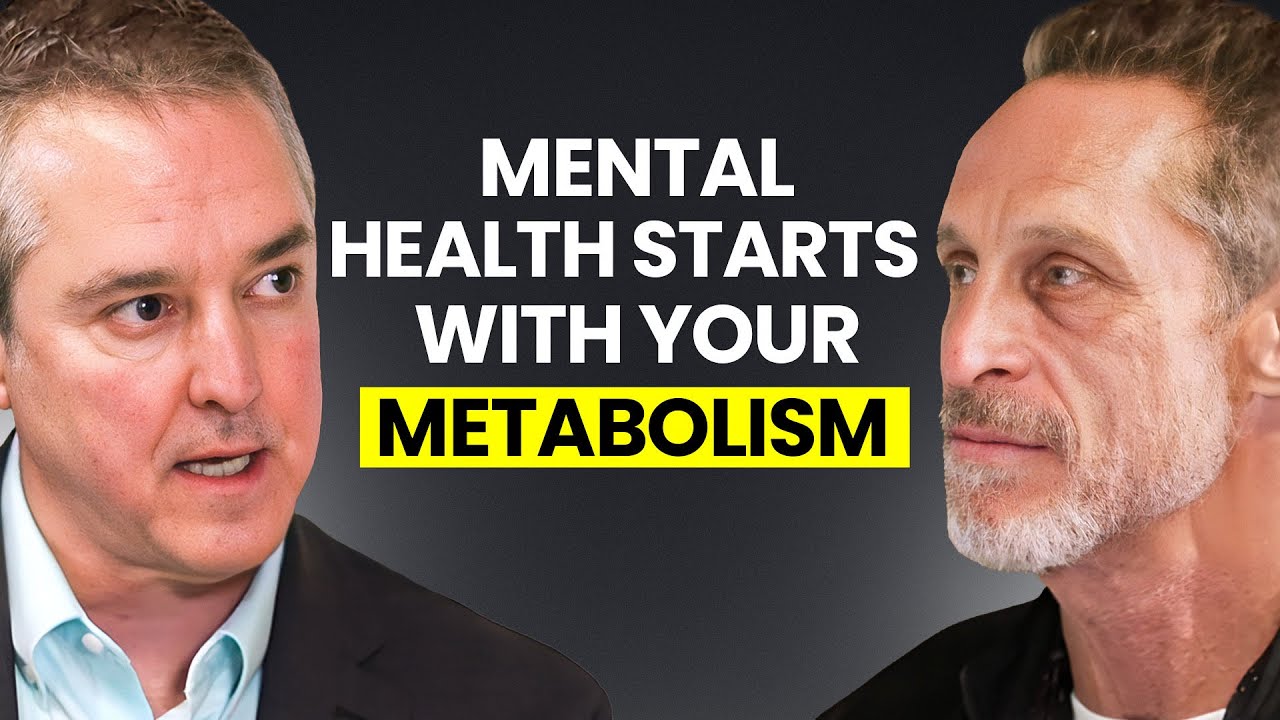
Harvard Doctor Exposes What's Wrong With Modern Psychiatry
Flashcards, Quiz, Mind Map, Micro-Podcast, Notes & YouTube Subscriptions are Studio features.
$4.99/mo · cancel any time
Generating flashcards…
Flashcards aren't available for this video right now. This can happen with very long or non-English videos.
Tap to reveal answer
Test your understanding of this video.
Generating quiz…
Quiz isn't available for this video right now. Try a shorter video or retry in a moment.
Building mind map…
Mind map isn't available for this video right now. Try a shorter video or retry in a moment.
Overview
This video features a crucial conversation between Dr. Mark Hyman and Harvard psychiatrist Dr. Christopher Palmer, exposing the fundamental flaws in modern psychiatry and introducing a revolutionary new paradigm: metabolic psychiatry. They argue that mental illnesses, currently skyrocketing alongside chronic physical diseases, are not fixed genetic brain disorders but rather systemic body problems driven by metabolic dysfunction and inflammation. The discussion is for anyone grappling with mental health issues, medical professionals seeking better solutions, and individuals interested in root-cause approaches to well-being. The most important insight is that by addressing underlying metabolic and biological imbalances, profound recovery, even from severe conditions like schizophrenia and bipolar disorder, becomes possible, offering immense hope. This shift matters because it challenges the prevailing narrative of hopelessness and chronic medication, advocating for treatable, reversible conditions and a more holistic, effective approach to mental health care.
Key Takeaways
- → Mental illnesses are incredibly widespread, affecting approximately 1 billion people annually, and their rates are dramatically increasing, mirroring the rise in chronic physical diseases. This correlation suggests a shared underlying biological basis rather than a mere coincidence. [0:00]
- → Traditional psychiatry predominantly views mental disorders as fixed, genetic brain problems, leading to a narrative of hopelessness where patients are often told they must manage symptoms with medication for life without addressing root causes. This perspective fosters a sense of being 'defective' rather than treatable. [4:29]
- → Dr. Palmer and Dr. Hyman propose that mental health conditions are fundamentally 'body problems that affect the brain' or 'systemic disorders.' This means that psychiatric symptoms are often manifestations of dysfunctions elsewhere in the body, such as the gut, immune system, or metabolic pathways. [9:09]
- → Metabolic dysfunction, encompassing issues like insulin resistance, inflammation, oxidative stress, and mitochondrial dysfunction, is identified as a final common pathway contributing to a wide array of chronic diseases, including all mental illnesses. Addressing these core metabolic issues is key to recovery. [22:40]
- → Adverse Childhood Experiences (ACEs) play a significant role in increasing the risk for mental disorders, as well as physical health conditions like obesity and cardiovascular disease. These traumas induce biological changes, affecting the epigenome and driving inflammation, demonstrating the interconnectedness of psychological and physical health. [28:00]
- → The gut-brain axis is crucial, with stress and trauma capable of altering the gut microbiome within hours, subsequently impacting overall body and mental health. This highlights that lifestyle interventions like diet and nutrition can be powerful tools to restore gut health and, consequently, improve mental well-being. [32:27]
- → Conventional psychiatric medications, while potentially life-saving in acute crises, are critically examined for their long-term harm. They are likened to chemotherapy, often impairing mitochondrial function, causing metabolic disorders like obesity and type 2 diabetes, and contributing to a 15-year reduction in lifespan among psychiatric patients. [41:38]
- → The new paradigm of metabolic psychiatry offers immense hope by reframing mental illnesses as treatable and potentially reversible conditions. It emphasizes a systematic, detective-like approach to identify and address the individual biological, psychological, social, and environmental factors contributing to metabolic dysregulation. [54:55]
- → Empirical metabolic treatments, such as the ketogenic diet, are showing remarkable promise in treating severe mental illnesses like schizophrenia, bipolar disorder, and chronic depression. This diet, which mimics fasting, is broadly anti-inflammatory and can modulate the immune system, leading to significant symptom remission.
- → Emerging research focuses on novel biomarkers, including autoantibodies that can block essential nutrients like folate and vitamin B12 from crossing the blood-brain barrier, leading to profound central nervous system deficiencies despite normal blood levels. Identifying these specific metabolic disruptions allows for targeted, effective treatments.
- → A broader revolution in medicine is called for, advocating for 'functional medicine' or 'network medicine' that treats the body as an interconnected system rather than isolated parts. This holistic approach seeks to identify and eliminate contributing factors (toxins, poor diet, stress) while adding supportive elements (nutrients, sleep, connection).
- → The medical community, including many mainstream psychiatrists, is showing increasing open-mindedness and a desire for better solutions, recognizing the limitations of current practices. This collective yearning for more effective treatments is driving the integration of metabolic and functional medicine principles into psychiatric care, signaling a hopeful future for mental health.
Timestamps
My Notes
Save personal notes for any video. Studio feature.
Turn this summary into audio you can listen to anywhere: commute, gym, or eyes-free.
Upgrade to Studio →Share this summary
Flashcards
What is the main…
Quiz
8 questions · Med…
Podcast
~2 min audio…
Unlock Studio tools for every summary
Flashcards, Quiz, Mind Map, Podcast, Notes | $4.99/mo, cancel anytime.
Try Studio →🤖 This summary was generated by AI and may contain inaccuracies. Always verify important information from the original video.
Writing your post…
We couldn't generate your post right now.
People also summarized

YouTube Video
This video by Andrei Jikh explores the concept of 'money reprogramming,' which refers to how technological adv…

YouTube Video
This episode of "Lifespan with Dr. David Sinclair" delves into the critical concept of "adversity mimetics" – …

YouTube Video
This video thoroughly explores the evolving landscape of software engineering in the age of Artificial Intelli…

YouTube Video
This video features an insightful interview with Yoshua Bengio, often hailed as one of the 'Godfathers of AI,'…

YouTube Video
This video features Nick Freitas reacting to and dissecting a powerful speech by Senator Marco Rubio at the Mu…

YouTube Video
This Kurzgesagt video dives into the increasingly popular weight-loss drugs like Ozempic, examining their mech…
LinkedIn doesn't support pre-filled text. Copy it, then paste when LinkedIn opens.
Facebook doesn't support pre-filled text. Copy it, then paste when Facebook opens.