
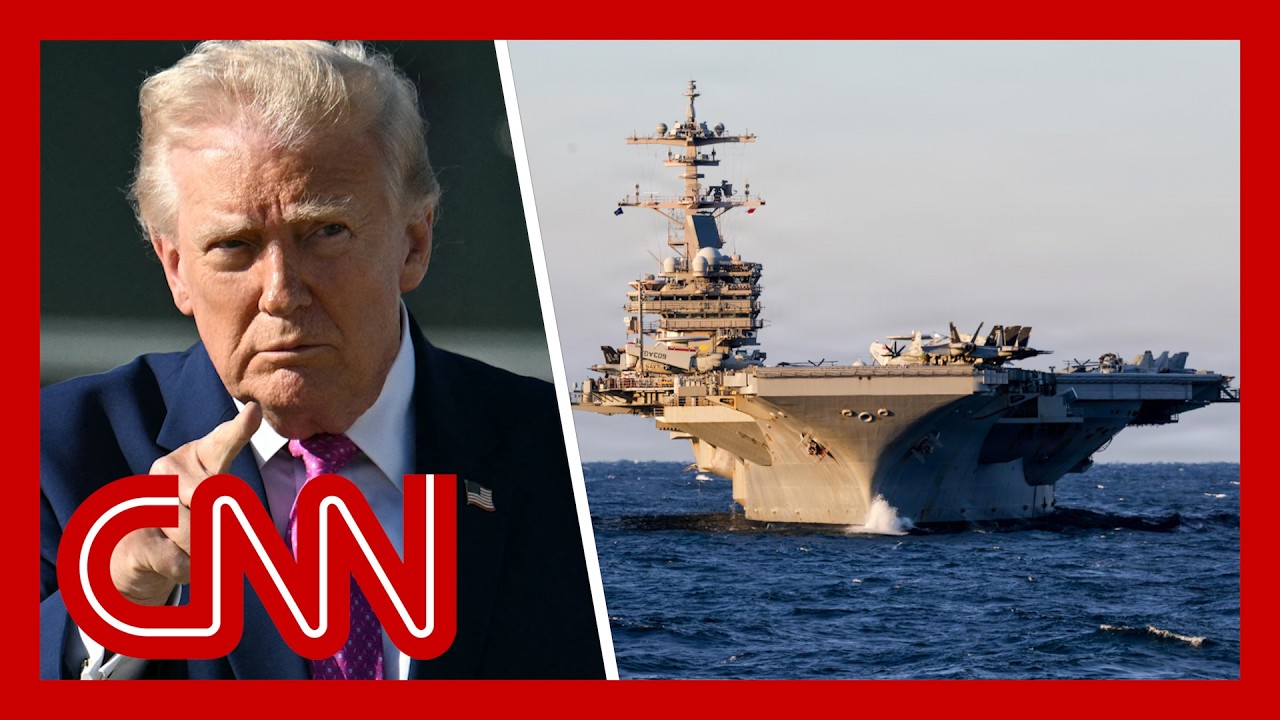
Trump says US Navy will blockade Strait of Hormuz
Flashcards, Quiz, Mind Map, Micro-Podcast, Notes & YouTube Subscriptions are Studio features.
$4.99/mo · cancel any time
Generating flashcards…
Flashcards aren't available for this video right now. This can happen with very long or non-English videos.
Tap to reveal answer
Test your understanding of this video.
Generating quiz…
Quiz isn't available for this video right now. Try a shorter video or retry in a moment.
Building mind map…
Mind map isn't available for this video right now. Try a shorter video or retry in a moment.
Overview
This CNN report details President Donald Trump's declaration that the U.S. Navy will blockade the Strait of Hormuz, preventing passage for any ship that has paid a toll to Iran. The video explores the potential effectiveness and implications of such a drastic measure following the collapse of U.S. peace talks with Iran. It features analysis from former NATO Supreme Allied Commander James Stavridis on military feasibility, and reactions from former U.S. Ambassador to the UN Nikki Haley and Senator Mark Warner on the political and strategic ramifications. The core argument centers on whether this aggressive stance is a bluff or a genuine, high-stakes escalation in U.S.-Iran relations, with significant implications for global trade and regional stability.
Key Takeaways
- → President Trump has announced a U.S. Navy blockade of the Strait of Hormuz, signaling a significant escalation in U.S.-Iran tensions. This action is framed as a response to the collapse of peace talks and aims to interdict ships paying tolls to Iran, a critical chokepoint for global oil supply. [0:00]
- → The potential effectiveness of such a blockade is questioned by experts, who suggest Iran might have retaliatory measures. This highlights the complex geopolitical chess game being played and the unpredictable nature of military and economic sanctions. [2:54]
- → Former NATO Commander James Stavridis provides military analysis on the feasibility and potential challenges of implementing a naval blockade in such a sensitive and strategically important waterway. [4:53]
- → Nikki Haley interprets Trump's statement as a strategic move to 'call Iran's bluff,' suggesting it's a tactic to pressure Iran rather than an immediate intent for full-scale military action. [7:06]
- → Senator Mark Warner expresses skepticism, believing that a blockade is unlikely to achieve the stated goal of opening the Strait of Hormuz for passage, implying it could lead to prolonged conflict or a stalemate.
- → The Strait of Hormuz is a crucial maritime passage through which approximately 30% of the world's seaborne oil passes, making any disruption to its traffic a matter of global economic concern.
- → The decision follows a breakdown in diplomatic efforts, suggesting a shift towards more coercive tactics by the Trump administration to achieve its foreign policy objectives regarding Iran.
- → The report underscores the high stakes involved in U.S.-Iran relations, where economic pressure, military posturing, and diplomatic maneuvers are constantly intertwined.
- → The potential for unintended consequences and further regional destabilization is a significant concern highlighted by the analysis of the proposed blockade.
- → The debate presented in the video reflects differing perspectives within U.S. foreign policy circles on the best approach to dealing with Iran.
Timestamps
My Notes
Save personal notes for any video. Studio feature.
Turn this summary into audio you can listen to anywhere: commute, gym, or eyes-free.
Upgrade to Studio →Share this summary
Flashcards
What is the main…
Quiz
8 questions · Med…
Podcast
~2 min audio…
Unlock Studio tools for every summary
Flashcards, Quiz, Mind Map, Podcast, Notes | $4.99/mo, cancel anytime.
Try Studio →🤖 This summary was generated by AI and may contain inaccuracies. Always verify important information from the original video.
Writing your post…
We couldn't generate your post right now.
People also summarized
YouTube Video
This video by Andrei Jikh explores the concept of 'money reprogramming,' which refers to how technological adv…

YouTube Video
This episode of "Lifespan with Dr. David Sinclair" delves into the critical concept of "adversity mimetics" – …

YouTube Video
This video thoroughly explores the evolving landscape of software engineering in the age of Artificial Intelli…
YouTube Video
This video features an insightful interview with Yoshua Bengio, often hailed as one of the 'Godfathers of AI,'…
YouTube Video
This video features Nick Freitas reacting to and dissecting a powerful speech by Senator Marco Rubio at the Mu…

YouTube Video
This video features a crucial conversation between Dr. Mark Hyman and Harvard psychiatrist Dr. Christopher Pal…
LinkedIn doesn't support pre-filled text. Copy it, then paste when LinkedIn opens.
Facebook doesn't support pre-filled text. Copy it, then paste when Facebook opens.