
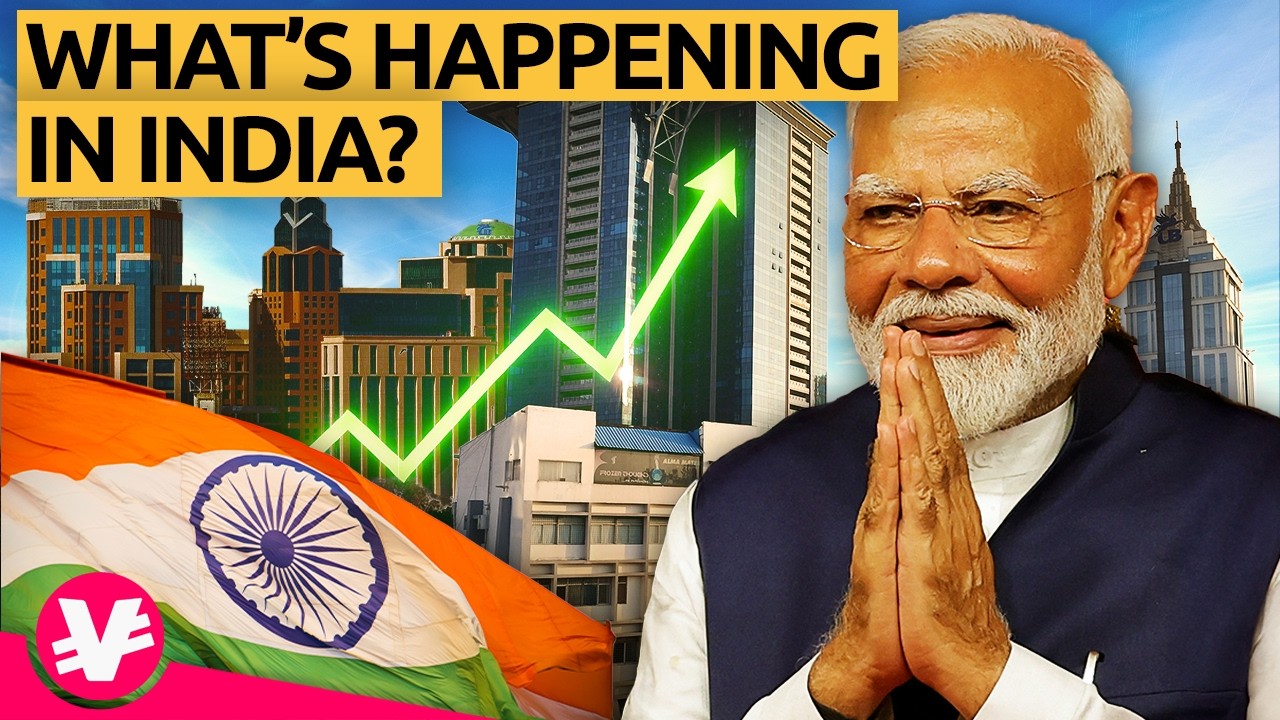
The U.S. Has Crushed India Commercially, but Its Economy Is Soaring to 8% | VisualEconomik EN
Flashcards, Quiz, Mind Map, Micro-Podcast, Notes & YouTube Subscriptions are Studio features.
$4.99/mo · cancel any time
Generating flashcards…
Flashcards aren't available for this video right now. This can happen with very long or non-English videos.
Tap to reveal answer
Test your understanding of this video.
Generating quiz…
Quiz isn't available for this video right now. Try a shorter video or retry in a moment.
Building mind map…
Mind map isn't available for this video right now. Try a shorter video or retry in a moment.
Overview
This VisualEconomik EN video explores the complex economic relationship between the United States and India, highlighting how the US has historically dominated trade while India's economy is experiencing rapid growth. It targets viewers interested in international economics, global trade dynamics, and emerging market trends. The main argument is that despite the US's commercial advantage, India's internal economic factors are driving its impressive GDP expansion. The most significant insight is that a nation's economic performance isn't solely determined by its trade balance with a dominant power, but also by its domestic market size, consumption, and investment. This understanding is crucial for a nuanced view of global economic power shifts and investment opportunities.
Key Takeaways
- → The United States has historically held a significant commercial advantage over India, evidenced by a larger share of global trade and stronger bilateral trade flows. This dominance has shaped their economic interactions for decades, with the US often dictating terms in various sectors. [0:00]
- → Despite the US commercial advantage, India's economy is exhibiting remarkable growth, projected to reach 8%. This growth is largely driven by domestic factors, underscoring that a strong trade balance is not the sole determinant of national economic health. [1:30]
- → India's massive domestic market and burgeoning consumer base are key drivers of its economic expansion. The increasing purchasing power of its large population fuels demand for goods and services, creating a vibrant internal economy. [3:45]
- → Foreign direct investment (FDI) plays a crucial role in India's economic ascent. The influx of capital from international companies seeking access to its growing market and skilled workforce contributes significantly to its GDP. [6:00]
- → The video implicitly contrasts India's growth trajectory with that of other nations, suggesting a unique path to economic development driven by internal consumption and investment rather than solely export-led growth. [9:00]
- → Technological adoption and a growing digital economy are increasingly contributing to India's GDP. Increased internet penetration and smartphone usage are opening new avenues for business and consumption. [12:00]
- → Government policies and reforms in India, such as 'Make in India' and initiatives to improve ease of doing business, are creating a more favorable environment for economic activity and attracting investment.
- → The narrative challenges the conventional wisdom that being a net importer or having a trade deficit automatically signifies economic weakness, particularly when accompanied by robust domestic growth.
Timestamps
My Notes
Save personal notes for any video. Studio feature.
Turn this summary into audio you can listen to anywhere: commute, gym, or eyes-free.
Upgrade to Studio →Share this summary
Flashcards
What is the main…
Quiz
8 questions · Med…
Podcast
~2 min audio…
Unlock Studio tools for every summary
Flashcards, Quiz, Mind Map, Podcast, Notes | $4.99/mo, cancel anytime.
Try Studio →🤖 This summary was generated by AI and may contain inaccuracies. Always verify important information from the original video.
Writing your post…
We couldn't generate your post right now.
People also summarized

YouTube Video
This video by Andrei Jikh explores the concept of 'money reprogramming,' which refers to how technological adv…

YouTube Video
This episode of "Lifespan with Dr. David Sinclair" delves into the critical concept of "adversity mimetics" – …
YouTube Video
This video thoroughly explores the evolving landscape of software engineering in the age of Artificial Intelli…
YouTube Video
This video features an insightful interview with Yoshua Bengio, often hailed as one of the 'Godfathers of AI,'…

YouTube Video
This video features Nick Freitas reacting to and dissecting a powerful speech by Senator Marco Rubio at the Mu…

YouTube Video
This video features a crucial conversation between Dr. Mark Hyman and Harvard psychiatrist Dr. Christopher Pal…
LinkedIn doesn't support pre-filled text. Copy it, then paste when LinkedIn opens.
Facebook doesn't support pre-filled text. Copy it, then paste when Facebook opens.