
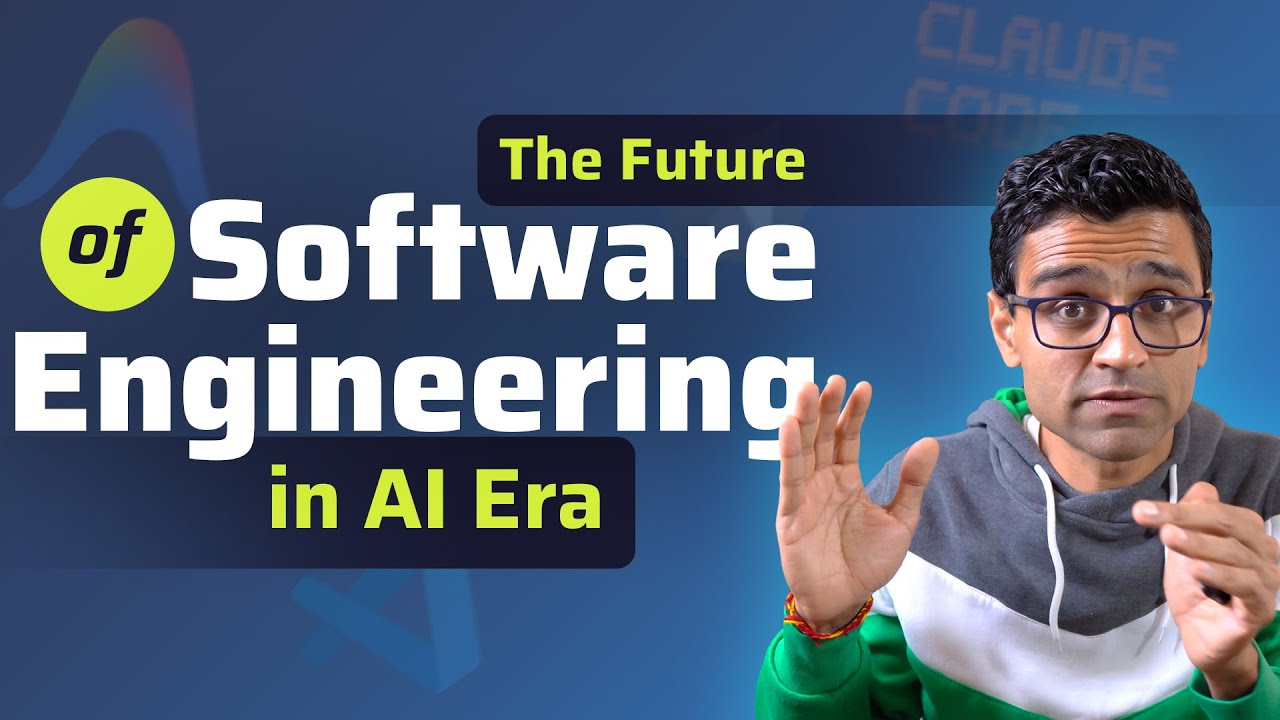
Future of software engineering in AI era
Flashcards, Quiz, Mind Map, Micro-Podcast, Notes & YouTube Subscriptions are Studio features.
$4.99/mo · cancel any time
Generating flashcards…
Flashcards aren't available for this video right now. This can happen with very long or non-English videos.
Tap to reveal answer
Test your understanding of this video.
Generating quiz…
Quiz isn't available for this video right now. Try a shorter video or retry in a moment.
Building mind map…
Mind map isn't available for this video right now. Try a shorter video or retry in a moment.
Overview
This video thoroughly explores the evolving landscape of software engineering in the age of Artificial Intelligence, addressing the common fear of job displacement head-on. It's tailored for software developers, product owners, and anyone in the tech industry concerned about the future of their careers. The core argument posits that while AI is a 'game-changer' for coding efficiency, it will not eradicate human roles; instead, it will transform them. The most important insight is the application of 'Jevon's Paradox' to software, suggesting that increased coding efficiency will exponentially boost the demand for software, thus creating new opportunities and shifting roles towards human orchestration and broader skill sets. This perspective matters because it offers a nuanced, optimistic, and actionable roadmap for software professionals to adapt and thrive, emphasizing skill development beyond pure coding.
Key Takeaways
- → AI-first development is a transformative shift where AI generates the majority of code, moving software engineers from primary coders to orchestrators who provide prompts, context, and validate outputs. This marks a fundamental change in development workflow, as exemplified by a staff engineer whose 95% of pull requests were AI-generated, making the human role more about guidance than creation. [0:00]
- → AI tools significantly enhance developer productivity by automating complex tasks like bug fixing and feature implementation across an entire tech stack. The demo with 'Cursor' showcased how AI could identify errors from screenshots and voice commands, then generate hundreds of lines of correct code for new features like comment sections, all with minimal human effort and impressive speed. [1:40]
- → The economic concept of Jevon's Paradox applies directly to software development: as AI makes coding more efficient and cheaper, the overall consumption and demand for software will increase, not decrease. This means the world will need more and better code, accelerating digital transformation for many organizations and fostering innovation. [6:20]
- → AI will enable small to medium-scale organizations to undertake digital transformation projects they previously couldn't afford or manage due to cost and time constraints. This increased accessibility will lead to more software projects, infrastructure upgrades, and overall technological advancement across various industries that were once lagging. [8:50]
- → The role of humans in software engineering is evolving into that of an 'orchestrator,' responsible for providing business requirements, legacy context, architectural boundaries, design suggestions, and coding styles to LLMs. Engineers will primarily focus on validation and iteration, ensuring AI-generated code meets specific criteria and performs as expected in complex, real-world scenarios. [10:50]
- → Future roles will consolidate, with the 'Software Development Engineer' and 'Product Owner' potentially merging into a new 'Builder' role. This future professional will possess a blend of technical coding skills (leveraging AI) with strong communication, business understanding, and deep domain knowledge, driven by the increased efficiency AI brings to core coding tasks. [13:30]
- → Software engineers must adapt by developing strong soft skills, deepening their understanding of business domains, and becoming proficient 'AI generalists.' The time saved by AI in coding should be invested in these areas to effectively manage AI tools, draft requirements, and ensure the delivered software aligns with overarching business goals. [17:20]
- → AI engineers will become crucial as integrating AI features into applications becomes standard. Developers will need specialized skills to seamlessly weave AI capabilities into existing and new software, indicating a vital, evolving skill set for the tech landscape. [19:15]
- → LLMs prove exceptionally useful in specific challenging scenarios, particularly when dealing with legacy projects that lack documentation, unknown logic, or require migration to new tech stacks. They also excel at building fast prototypes, providing significant leverage where human effort would typically be slow and arduous.
- → Fears of widespread job loss due to AI are overhyped and often based on overly optimistic timelines for full automation. Historical examples, like Elon Musk's inaccurate self-driving car predictions, demonstrate that technological evolution and societal adoption are much slower than anticipated, ensuring human roles persist for the foreseeable future, albeit in an evolved form.
Timestamps
My Notes
Save personal notes for any video. Studio feature.
Turn this summary into audio you can listen to anywhere: commute, gym, or eyes-free.
Upgrade to Studio →Share this summary
Flashcards
What is the main…
Quiz
8 questions · Med…
Podcast
~2 min audio…
Unlock Studio tools for every summary
Flashcards, Quiz, Mind Map, Podcast, Notes | $4.99/mo, cancel anytime.
Try Studio →🤖 This summary was generated by AI and may contain inaccuracies. Always verify important information from the original video.
Writing your post…
We couldn't generate your post right now.
People also summarized
Browse Ai Machine Learning →
YouTube Video
This video addresses the pervasive issue of AI-generated "slop" in the realm of "vibe coding," where applicati…
YouTube Video
This Y Combinator Startup School video, featuring YC Partner Diana Hu, explores the paradigm shift in company …

YouTube Video
This video by Suno Zone + AIs provides a comprehensive guide to advanced techniques for using Suno AI to gener…

YouTube Video
This video from Nurtured First serves as a comprehensive guide for parents navigating the increasingly complex…

YouTube Video
This video from the "Species | Documenting AGI" channel, presented by Drew, explores a deeply concerning incid…

YouTube Video
This video by Nate B. Jones explores the concept of "AI coding" and breaks it down into five distinct levels, …
LinkedIn doesn't support pre-filled text. Copy it, then paste when LinkedIn opens.
Facebook doesn't support pre-filled text. Copy it, then paste when Facebook opens.