
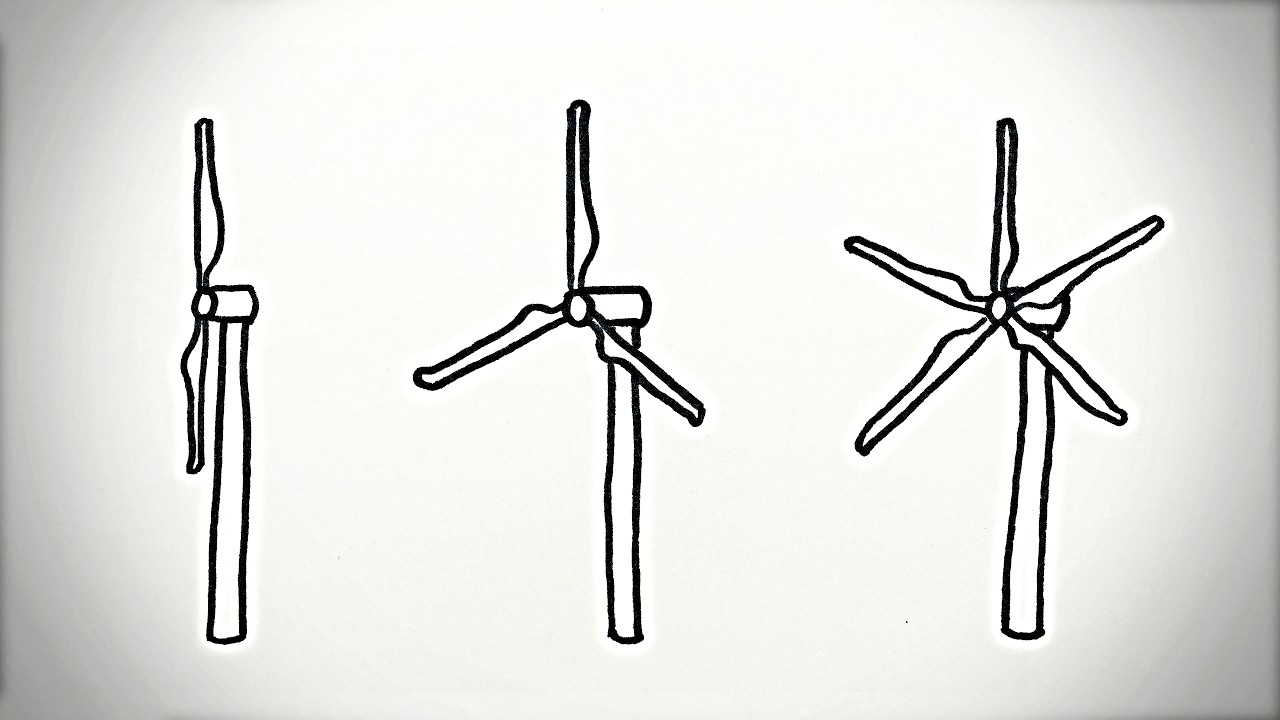
Why Do Wind Turbines Have Three Blades?
Flashcards, Quiz, Mind Map, Micro-Podcast, Notes & YouTube Subscriptions are Studio features.
$4.99/mo · cancel any time
Generating flashcards…
Flashcards aren't available for this video right now. This can happen with very long or non-English videos.
Tap to reveal answer
Test your understanding of this video.
Generating quiz…
Quiz isn't available for this video right now. Try a shorter video or retry in a moment.
Building mind map…
Mind map isn't available for this video right now. Try a shorter video or retry in a moment.
Overview
This MinutePhysics video delves into the intriguing question of why the vast majority of wind turbines are designed with three blades, rather than one, two, or more. Aimed at anyone curious about renewable energy and basic engineering principles, the video systematically breaks down the aerodynamic and mechanical reasons behind this prevalent design. The core insight is that three blades represent an optimal balance between efficiency, stability, and cost-effectiveness. Understanding this choice is crucial for appreciating the engineering compromises that lead to the widespread adoption of modern wind energy technology.
Key Takeaways
- → The primary reason for three blades is aerodynamic efficiency; it allows the turbine to capture a significant portion of the wind's kinetic energy without becoming overly complex or inefficient. [0:00]
- → Two blades can be more efficient in certain conditions, but they suffer from a phenomenon called 'periodic torque variation,' which leads to vibrations and increased stress on the structure, making them less desirable for large-scale turbines. [0:30]
- → One-bladed turbines are theoretically possible but face significant balancing issues and are impractical due to the extreme forces and vibrations they would experience. [1:15]
- → Increasing the number of blades beyond three, while potentially capturing slightly more energy at very low wind speeds, quickly leads to diminishing returns and introduces greater drag and structural complexity. [2:00]
- → The three-bladed design strikes a sweet spot, offering a good compromise between energy capture, rotational stability, and manufacturing costs. It's a robust solution that has proven its worth in diverse environments. [3:00]
- → Cost-effectiveness plays a significant role; the added expense of manufacturing and maintaining additional blades often outweighs any marginal increase in energy production beyond three. [4:00]
- → The visual appearance and noise produced by a turbine can also be influenced by the number of blades. Three blades generally offer a more aesthetically pleasing and less obtrusive operation compared to designs with fewer or many more blades. [5:00]
- → The physics behind blade design involves lift and drag forces. The angle of attack and the shape of the blades are optimized in a three-bladed system to maximize the torque generated by the wind.
Timestamps
My Notes
Save personal notes for any video. Studio feature.
Turn this summary into audio you can listen to anywhere: commute, gym, or eyes-free.
Upgrade to Studio →Share this summary
Flashcards
What is the main…
Quiz
8 questions · Med…
Podcast
~2 min audio…
Unlock Studio tools for every summary
Flashcards, Quiz, Mind Map, Podcast, Notes | $4.99/mo, cancel anytime.
Try Studio →🤖 This summary was generated by AI and may contain inaccuracies. Always verify important information from the original video.
Writing your post…
We couldn't generate your post right now.
People also summarized

YouTube Video
This video by Andrei Jikh explores the concept of 'money reprogramming,' which refers to how technological adv…

YouTube Video
This episode of "Lifespan with Dr. David Sinclair" delves into the critical concept of "adversity mimetics" – …

YouTube Video
This video thoroughly explores the evolving landscape of software engineering in the age of Artificial Intelli…

YouTube Video
This video features an insightful interview with Yoshua Bengio, often hailed as one of the 'Godfathers of AI,'…

YouTube Video
This video features Nick Freitas reacting to and dissecting a powerful speech by Senator Marco Rubio at the Mu…

YouTube Video
This video features a crucial conversation between Dr. Mark Hyman and Harvard psychiatrist Dr. Christopher Pal…
LinkedIn doesn't support pre-filled text. Copy it, then paste when LinkedIn opens.
Facebook doesn't support pre-filled text. Copy it, then paste when Facebook opens.